GARY IS FINE
AND THAT IS
THE PROBLEM
Somewhere, a company is spending a fortune to win him.
He has no idea they exist.
Gary is fifty-one. He has been with the same bank since he was nineteen. He shops at a supermarket he drives past two better ones to reach. He buys the same trainers he always buys, and his phone is four years old, and all of it works well enough that he has never once thought about changing any of it.
Gary is not stubborn. He is not loyal. He just has a life, and his life is full, and none of these small things are worth reopening. They were settled years ago. They are fine.
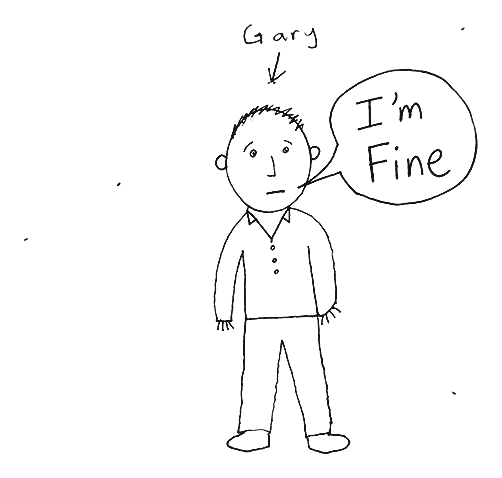
You know Gary. You might be Gary. There is something in your own life right now that is worse than it needs to be, and you have quietly decided to live with it, because fixing it is more trouble than it is worth. That feeling, the one that keeps you exactly where you are, is the most powerful force in any market. Almost nobody plans for it.
Meanwhile, in an office Gary will never see, a company has decided he is going to be their customer.
They have built something better than the thing he uses now. Faster, cleaner, cheaper, less painful. They have a chart that proves it. They know exactly how they beat the big familiar name everyone already uses, feature by feature, tick by tick. And they have a plan. The plan is to show Gary the difference, clearly enough that he switches.
The plan has one flaw. It pictures Gary sitting there,
holding both options, choosing between them.
He isn’t. He is at home. The great contest between this company and the one he already uses is happening somewhere he has never been and could not find if he tried. He does not know it exists. If you told him about it, he would shrug, because he already has a way of doing this thing, and it is fine.
And fine is almost impossible to beat.
Not because Gary loves what he has. Because leaving it is work. To switch, he first has to notice there is a problem at all, which he hasn’t. Then find the alternatives, work out who to trust, learn something new, and unpick a thing he already understands and never thinks about. And if it goes wrong, he is the one who chose it.
Set against all of that, “ours is better” is a very small thing to offer.
This is the trap. A company builds something far better than the old way, cannot understand why the world has not switched already, and arrives certain the difference will speak for itself. Then it waits, and nothing happens. The product is not the problem. Gary was never unhappy in the first place.
The familiar option comes with something no chart ever shows. It feels safe. The bank everyone knows feels safe. The supplier the whole industry uses feels safe. The system signed off years ago feels safe. Even a slow, annoying process feels safer than being the person who stood up and suggested replacing it. Nobody is thanked for keeping things the same. But they can be blamed for the new thing that went wrong.
So Gary is not choosing between this company and its rival. He never was. He is choosing between changing and staying still, and staying still wins almost every time, because it happens on its own. He does not lift a finger. He just keeps living the way he already lives.
This is where the effort gets wasted. The company studies its rivals, sharpens its pitch, and explains, beautifully, why it wins. All of it aimed at someone already standing in the shop, weighing it up. But that person did the hard part long ago. They decided to buy. Gary hasn’t, and there are far more Garys than there are people in the shop. A company can make the best thing anyone has ever seen and get nowhere, because the people it is built for never got as far as comparing anything.
So Gary will never move toward something better. He moves away from something that has started to hurt him.
And it does hurt, quietly. The half-hour he loses every week to the slow way. The thing that breaks every so often that he long ago accepted as normal. He stopped noticing these years ago. They are the price of fine, and he has never once added them up. Show him that price, in plain words he recognises, and the familiar option stops feeling free. Once standing still has a cost of its own, moving is finally worth it.
Working out why Gary does nothing is the easy part. Making him act on it is the hard bit, and the bit almost everyone skips.
The real job comes before any of that. Make Gary look up. Make him feel, for one second, that standing still is its own kind of risk, and not the safe bet he always took it for. Do that, and the competition takes care of itself. That was never the hard part. Getting Gary to turn his head was.
Every market has a Gary. Yours too.
He is not choosing between you and your rival. He is choosing between changing and staying still, and right now, staying still is winning.
That is the part I help with. Tell me about your Gary.
annaliisa@tinyforce.cc