I’M TOO SCARED
TO PREVENT
MY DEMENTIA
Dementia awareness keeps telling us what to fear.
I’m not sure fear is what we’re short of.
I had been looking at some of the things charities do so routinely that nobody really questions them anymore. In the last piece, it was the charity website: I realised that if I needed help, I probably would not go to one, because somewhere along the way I had learned to expect the ask before the help.
Then I noticed I do something similar with charity advertising.
If I come across a charity advert, I quickly scroll past it or switch channels. Unless somebody has told me it is unusually good, that it breaks a stereotype or actually helps the people it is about, I assume I know roughly what is coming. Something sad. Something frightening. Something designed to make me feel the seriousness of it.
So when I saw a mention of a new Alzheimer’s Society film,
I would normally have carried on scrolling. This time I looked, because I had started wondering about that behaviour itself.
The film was about Rachel, who is living with dementia, but her husband was speaking to us. Near the beginning he said that Rachel had made the first film herself, before adding, “It’s not so easy now.”
I wanted to know what he meant, which led me down a rabbit hole of three films made over three years. Alzheimer’s Society describes the 2026 film as the second instalment of A Personal Appeal, this time told from the perspective of Rachel’s husband, Mark, as her dementia progresses.
The earliest, The Long Goodbye, features a son talking about his mum. He describes her dying over and over: when she couldn’t prepare a roast, when she couldn’t get dressed, when she forgot his name. The advert is built for a devastating gut-punch: “With dementia, you don’t just die once. You die again and again and again.”
His mum was still alive through all of those earlier losses. Her physical death, in the end, was just the last one.
A year later, Rachel speaks directly to camera, recently diagnosed. She talks about losing words, the fear of no longer being able to use a knife and fork, and the worry that caring for her will ruin her daughter’s life. A year after that, Rachel appears again, but now her husband is speaking. She won’t eat. She has said cruel things. He is trying to keep the memories alive.
By the end of the three films, the vague thing I had spent years not wanting to think about had become very specific. That is what had been waiting behind the advert I would normally have scrolled past. And having finally made myself look at it, everything in me wanted to go back to doing exactly what I had always done.
Look away.
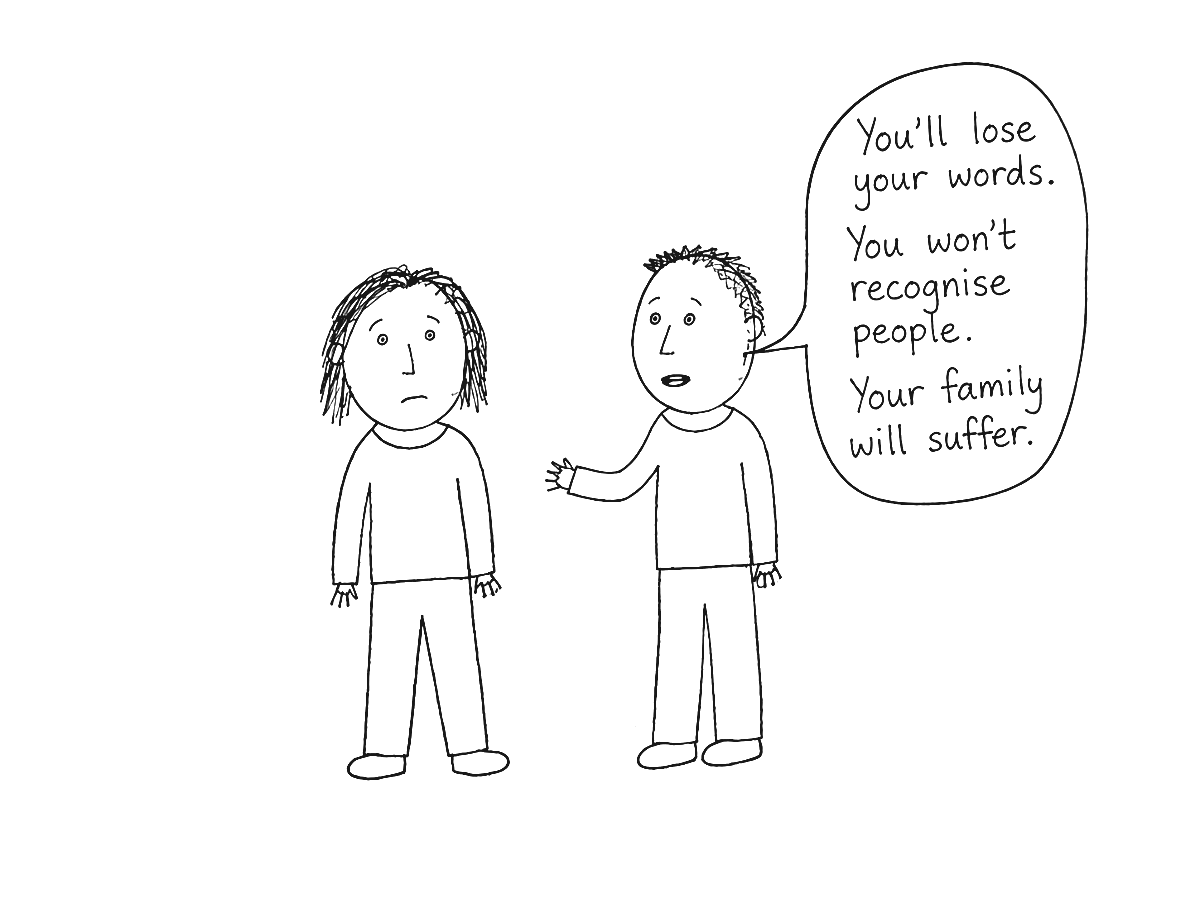
Not because I want dementia made prettier than it is, but because it frightens me. I already wanted not to get dementia. I already wanted the people I love not to have to care for me. Making the future more frightening could make the reason to act bigger, but it could not necessarily make me more able to do anything about it.
Then the fear gets turned towards me.
I came across a newspaper interactive sponsored by Alzheimer’s Society asking whether I was at risk of dementia. It takes you through fourteen questions based on the potentially modifiable risk factors identified by the 2024 Lancet Commission. Do you struggle to hear? Do you smoke? Do you exercise? What about air pollution, education and social connection?
The Lancet Commission estimates that the combined population-attributable fraction for those fourteen potentially modifiable risk factors is about 45%, and says modifying them might prevent or delay nearly half of dementia cases. Importantly, it also says prevention requires both policy change and individually tailored interventions.
But somewhere in the quiz, I noticed something odd.
I already know smoking, high cholesterol and drinking too much are bad for me. The additional information is that these things might increase my risk of dementia. But dementia no longer feels like a neutral medical condition. I have just watched three years of adverts showing me what it might mean: dying again and again, and ruining the lives of those I love.
Now I am being invited to inspect my own body and behaviour for signs that I might be heading there. Whatever the intention, this is the sequence I encounter: first I am shown dementia at its most frightening. Then I am asked to inspect my own life for the things that might lead me there.
But knowing the reason to act is not the same thing as being able to act.
The fourteen questions are grouped together as risk factors, but from the point of view of actually doing something, they are completely different problems. Smoking is a behaviour. High cholesterol may mean a blood test, a GP and treatment. If I live beside a heavily polluted road, I cannot personally clean the air. And if I am socially isolated, telling me it increases my dementia risk does not create somebody for me to spend Saturday afternoon with.
Potentially modifiable at population level does not mean personally controllable by the person answering the question.
A risk factor isn’t a behaviour.
When I went back through the quiz choosing the high-risk answer to everything, most of the solutions belonged to somebody else. RNID for my hearing. My GP for blood pressure. The NHS for exercise. Mind for depression. If somebody is already isolated, telling them to go and find social opportunities feels almost circular.
The barrier has become the instruction.
Knowing what raises my risk doesn’t remove whatever was stopping me reducing it.
More fear. More responsibility. Not necessarily more ability.
For a while, I thought this avoidance was simply something about me. Then I started reading more about how people talk about dementia.
In 2016, Alzheimer’s Society’s own research found dementia was the most feared health condition in the UK. Almost two-thirds of people surveyed, 62%, felt a diagnosis would mean their life was over. In the same research, 52% said that if they experienced confusion or problems recalling recent events, they would wait until the problem had become serious enough to affect work and personal life before visiting their GP.
The message Alzheimer’s Society used then was almost the opposite of the one I had just watched:
Life doesn’t end when dementia begins.
The charity said the campaign was intended to tackle myths and misunderstandings, confront worries and encourage people to seek diagnosis and support.
Eight years later came The Long Goodbye. This time, the Society was trying to solve a different problem. It said only one in ten people knew dementia was the UK’s biggest killer, and argued that low public understanding made it easier for political, health and social-care leaders to avoid addressing the problem. Its stated answer was to “show the public how devastating dementia is” so the disease became the priority it believed it needed to be. Its own stated objectives for the campaign, as recorded by the advertising regulator, were to raise awareness that dementia was the leading cause of death in the UK and to deliver more support to carers.
When I first thought, I’m too scared to prevent my dementia, I meant it literally. I would rather close the quiz and have however many years I have without rehearsing the bad ones.
But there is something else inside the fear.
When I imagine having dementia, I imagine what I might do to everybody else. I imagine my partner exhausted, my family trying to work out social care when they are already at breaking point. I imagine becoming the reason somebody I love cannot sleep, cannot leave the house without arranging for a handover. Rachel said it out loud: she worries caring for her will ruin her daughter’s life.
I could probably face knowing that terrible things might happen to me if I knew the people around me would be looked after when they did. If there was somewhere we went after diagnosis. If my partner could have a day off without spending months fighting for it. If practical care actually arrived.
If somebody could say: this is what happens next, and we have you.
The more I thought about it, the less my fear seemed to be only about dementia. It is about what happens around the disease. Whether the help turns up. Whether the people doing the caring are expected to absorb whatever the system cannot provide.
Alzheimer’s Society’s own 2025 research makes that worry less abstract. Among unpaid carers, 56% said they did not know who to contact for social care support. And among those receiving professional care in their own homes, only 34% felt that all or most of their needs were being met.
I’m not only frightened of dementia itself. I’m frightened
of what happens once dementia
enters a life.
This is where the whole thing becomes incredibly complicated.
The Long Goodbye generated 235 complaints to the Advertising Standards Authority. The ASA ultimately did not uphold them, concluding that although the ads were likely to cause potentially significant distress to some people, particularly those recently diagnosed, that distress was justified by the overall message.
And by Alzheimer’s Society’s own measures, the campaign worked.
It was reported to have achieved the charity’s highest-ever public awareness levels and a 115% increase in web donations, despite
not being a fundraising campaign. After evaluating the data and the criticism, the Society decided to run it again. It first aired in March and April 2024, and returned to air in October 2025, this time with
the charity’s Dementia Support Line number added to the end.
Perhaps the uncomfortable answer is that fear works. It gets attention. It makes dementia harder for politicians to ignore. And the charity needs those things.
One could easily argue that this is exactly why the charity has
to use these tactics. If the social care system is broken, perhaps
one way to shock decision-makers into paying attention to the care people desperately need is to put the raw, terrifying devastation of the disease on every screen in the country.
But that leaves a trade-off.
I am also the person scrolling past. I am the person who takes the risk quiz and wants to close it. I now know that fear and misconceptions have previously been treated by Alzheimer’s Society itself as barriers to confronting dementia and seeking help. And somebody already living with dementia has to live inside the picture after everybody else has finished looking at it.
A kinder advert cannot fix a fractured care system. Neither can a scarier one. Some of the answer has to exist before the communication: practical care, continuity, respite.
We don’t need to make dementia frightening enough to act. We need to make the future supported enough to face.
But I keep coming back to two moments in Alzheimer’s Society’s own history.
In 2016, it was telling people life doesn’t end when dementia begins, after finding that 62% thought a diagnosis meant exactly that.
In 2024, a campaign built around a woman dying “again and again and again” became what the Society later described as its most powerful campaign ever in driving engagement.
Both things can be true. The communication can work brilliantly against the goals set for it, while making the disease harder for someone like me to face.
So perhaps the question was never whether fear works.
It is who it works for.
I only managed to look at any of this by telling myself it was an interesting problem. I put the frightened person aside and became someone studying a question instead. It was the only way I could stand to keep reading.
Now that it is written, I will go back to being scared.
The difference is that I get to.