Low-key kind
They asked for awareness.Everyone was already noticing.
A one-day charity brief that became a national outdoor campaign about the awkward little things people do when they’re trying to be kind. Research, strategy, naming, identity, copy, design, website and media outreach by TINY FORCE, for Unique, the rare chromosome and gene disorder charity.
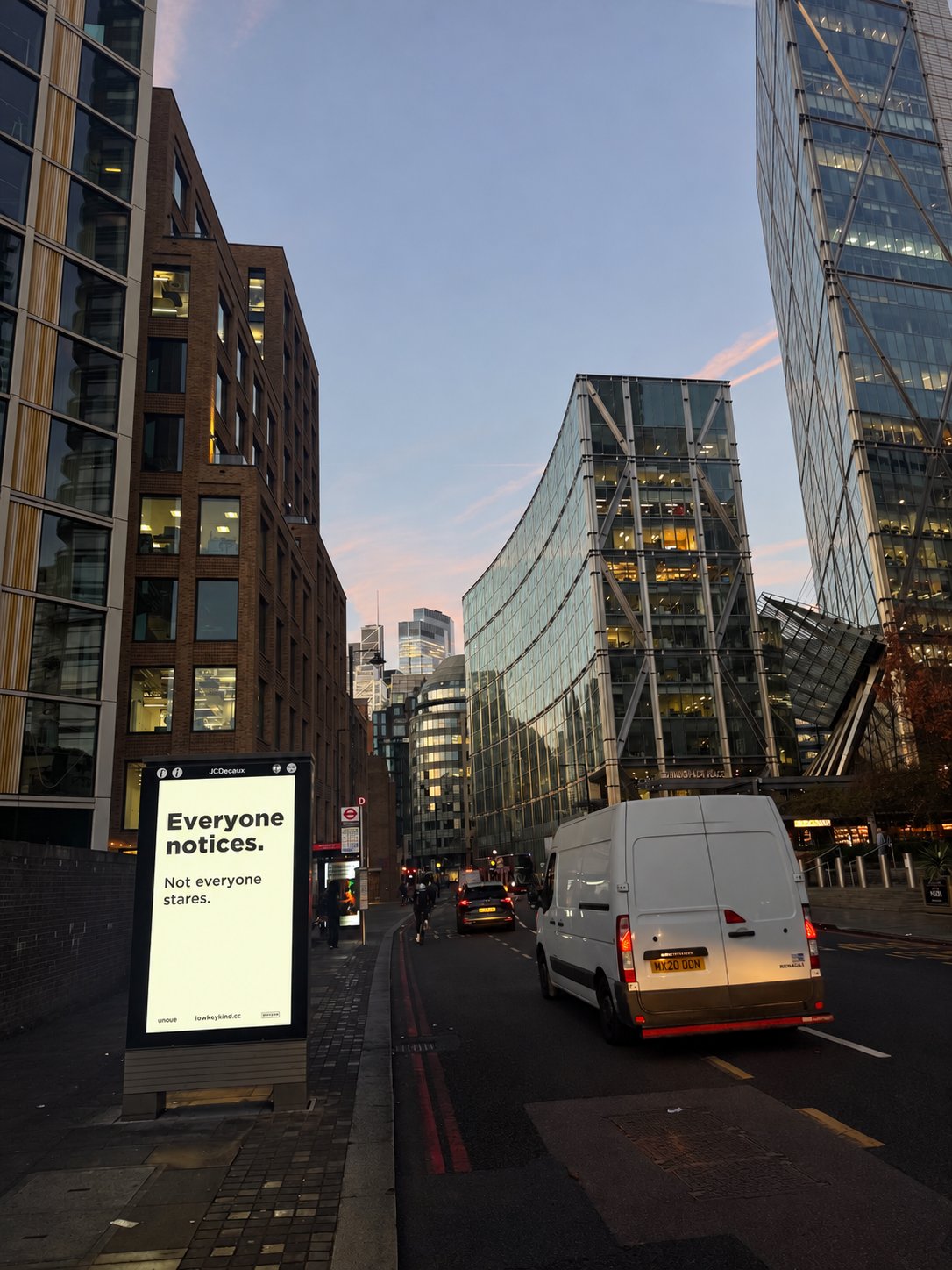
UK-wide
outdoor campaign on JCDecaux sites across the country
225
placements confirmed at launch
£0
media cost to Unique, donated through the JCDecaux Community Channel
1 person
from research to rollout, working directly with Unique
(Details)
(Challenge)
Thousands of rare conditions. No single story that could speak for all of them.
Unique supports families affected by rare chromosome and gene disorders. Many are so rare that only a handful of families worldwide share the same diagnosis.
That makes the usual awareness campaign difficult. No single condition. No recognisable symptom. No representative face to put on a poster.
And I didn’t want to turn another family’s difficult experiences into something for strangers to feel sad about.
(Goal)
Reach people who have never heard of Unique. Give them something useful, not another reason to feel guilty.
Unique has spent over 40 years helping families find information, answers and each other. But people who don’t have a direct connection to rare chromosome disorders are unlikely to go looking for the charity.
An awareness day might get someone’s attention for a moment.
I wanted to find something that could change an ordinary interaction long after the campaign was gone.
(Result)
From one awareness day to hundreds of outdoor placements across the UK.
An independent campaign identity, a nationwide JCDecaux outdoor launch, an interactive website built around real family experiences, a live sightings map and an ongoing social campaign.
All developed through TINY FORCE, with the outdoor media provided at no cost to Unique.
(01 · Thirteen routes died first)
The problem wasn’t finding an emotional story. There were too many.
I explored thirteen directions.
Two families meeting for the first time. A film about strangers reacting in a café. A campaign about what it means to be ordinary.
Some were moving. One had some of the best writing in the project.
But they all put families at the centre of a story for everyone else to watch.
The public might feel something, perhaps even learn something, then get on with their day.
What would actually happen differently the next time they met someone who looked, moved or communicated differently?
So I stopped asking how to make people understand rare conditions and started looking at how people behave when they encounter difference.
(02 · I asked both sides of the same moment)
It turned out people weren’t always sure what kindness should look like.
I ran two surveys. One with parents in the Unique community, the other with members of the public.
I wasn’t interested in asking people whether they cared. Most people would say yes.
I wanted to know what actually happened when somebody wasn’t sure how to react.
69%
of public respondents had experienced that uncertainty.
35%
thought doing nothing or leaving was the right response to a distressed child.
81%
said they would follow clear guidance if it existed.
The parents’ responses showed the other side of those encounters. Nine of twelve mentioned staring as something that could turn an ordinary outing into an event. Nine had stopped going to particular places.
But it was their positive experiences that stayed with me.
Someone had offered a cup of tea. Someone had played with their child. Someone had spoken directly to them rather than through a parent.
Small things, remembered years later.
What made them important wasn’t that somebody had gone out of their way to be especially kind.
It was that nobody had made a big thing of it.
(03 · Then I caught myself doing it)
The warmer smile. The softer voice. The sympathetic head tilt.
I realised I did it too.
When I’m around someone different from me, I sometimes become a slightly more careful version of myself.
A bit warmer. A bit more helpful. A bit too conscious of doing the right thing.
None of it comes from a bad place.
But imagine going to Tesco, getting on a bus or taking your child to the park, and having person after person make their own tiny adjustment around you.
One person doing it is hardly noticeable. A whole day of it is something else.
The gap wasn’t empathy.
It was choreography.
There is a term for this kind of behaviour: over-accommodation.
And telling people they’re getting kindness wrong seemed likely to make them even more self-conscious.
The campaign couldn’t make people more afraid of saying or doing the wrong thing.
It had to help them relax.
(04 · The idea)
Low-key kind.
Keep the kindness. Lose the extra.
Most awareness campaigns ask for more.
More empathy. More understanding. More attention.
This one asks people to do a little less.
Notice without staring. Help without taking over. Speak to someone without changing your whole personality.
Not pretending difference doesn’t exist. Not ignoring someone because you’re scared of getting it wrong.
Just treating an everyday interaction like an everyday interaction.
Not care less. Perform less.
Something people could recognise in themselves without feeling attacked, and actually use the next time they found themselves in that situation.
(05 · Taking it into the street)
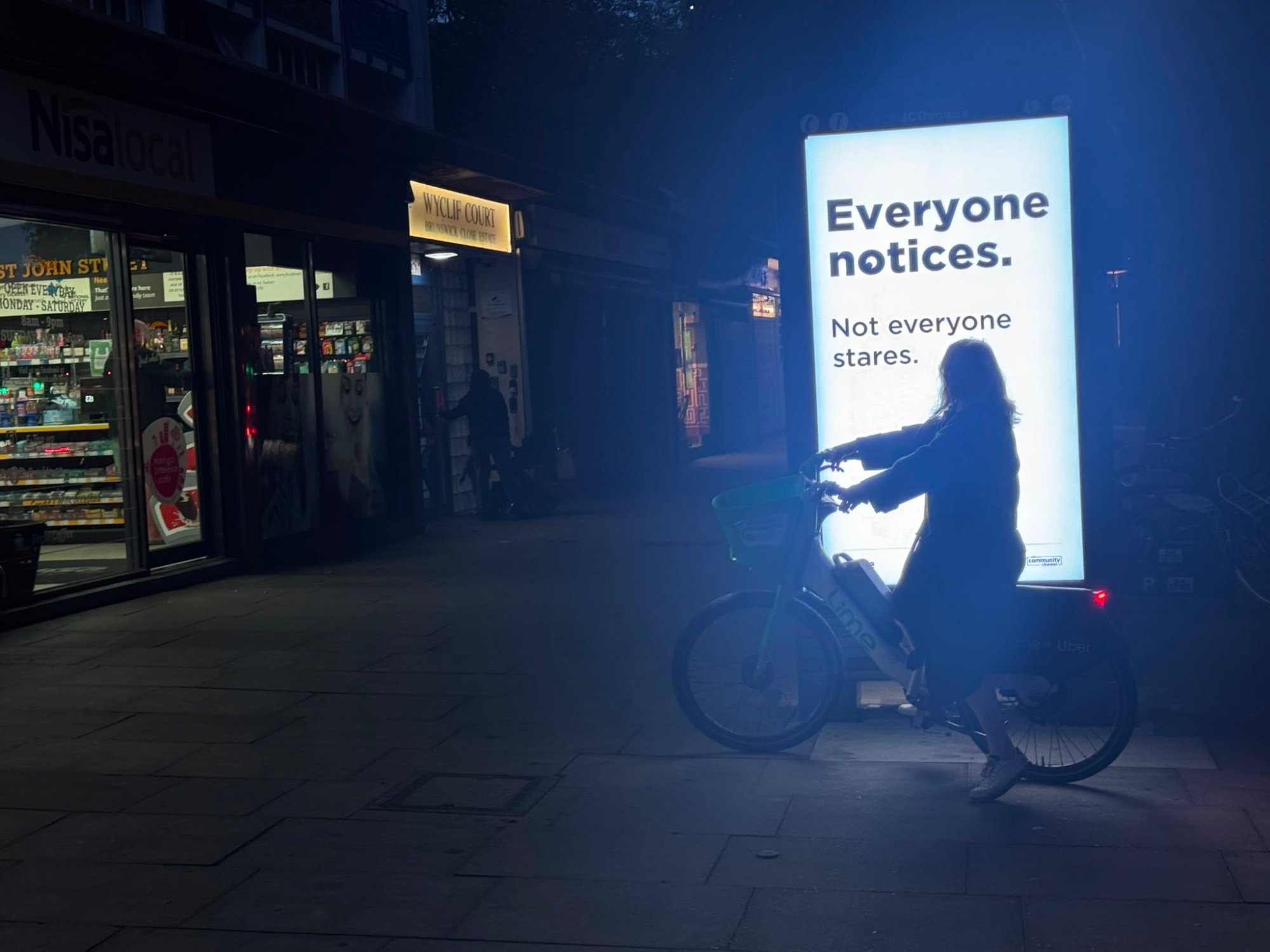
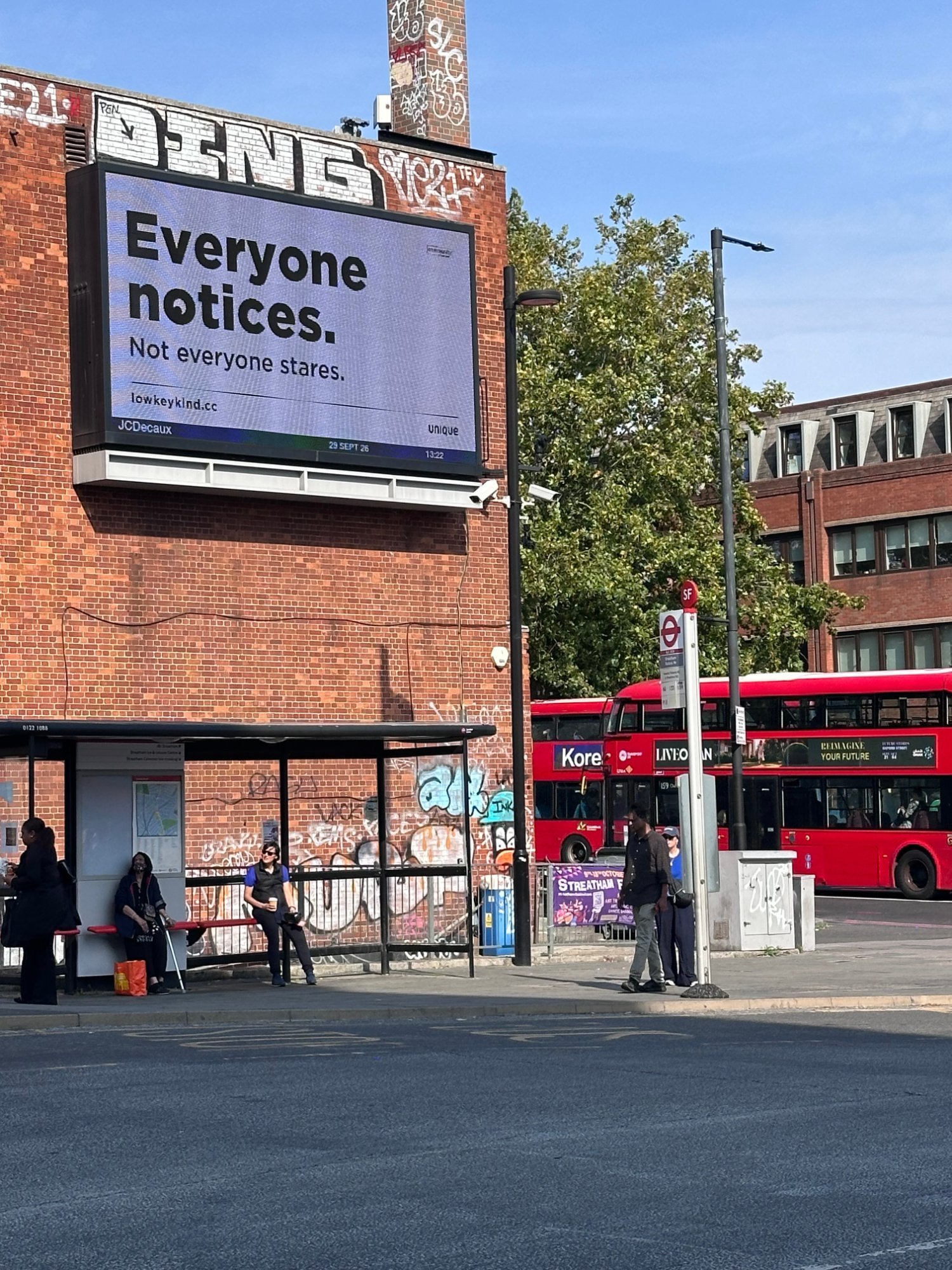
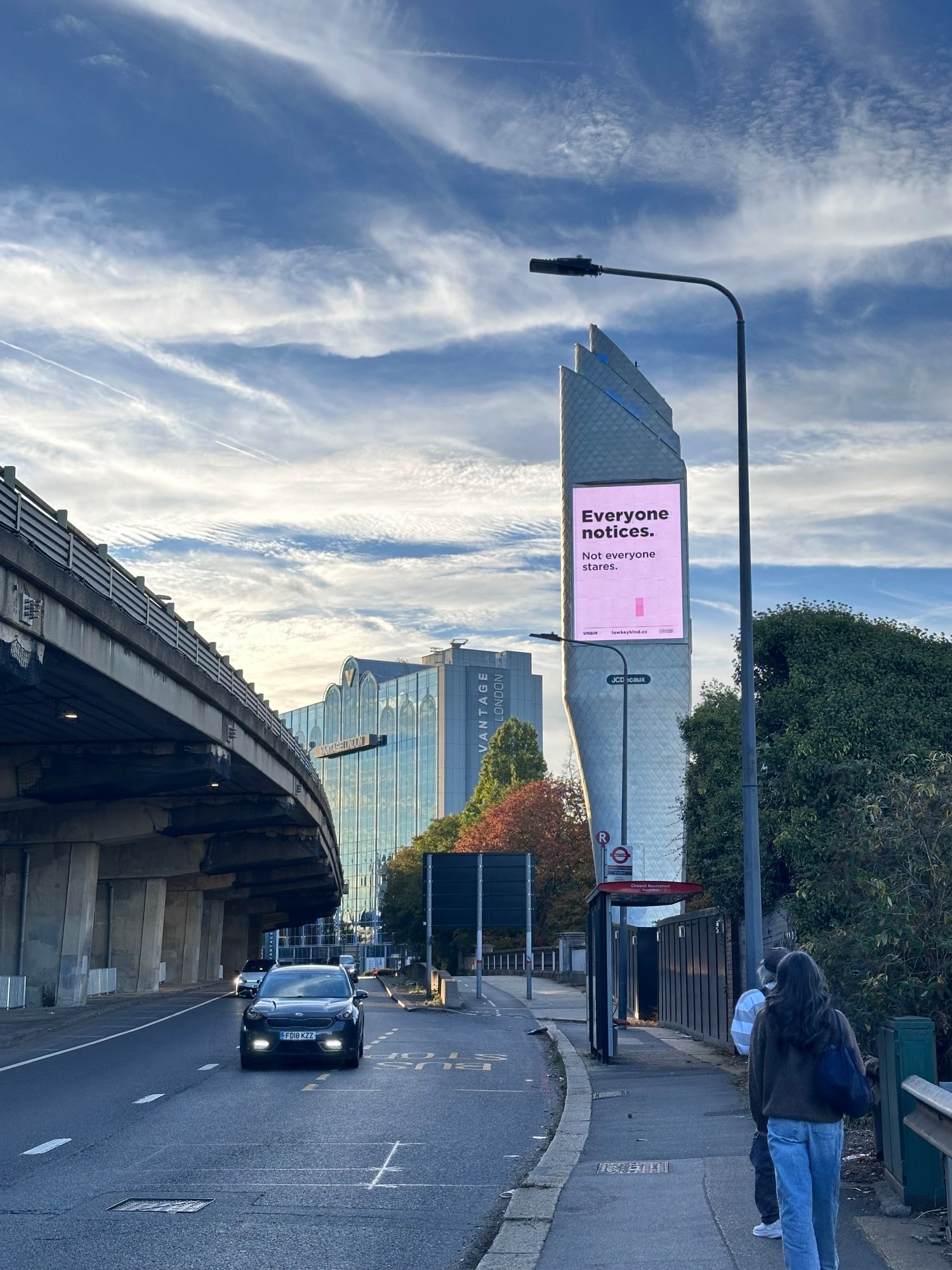
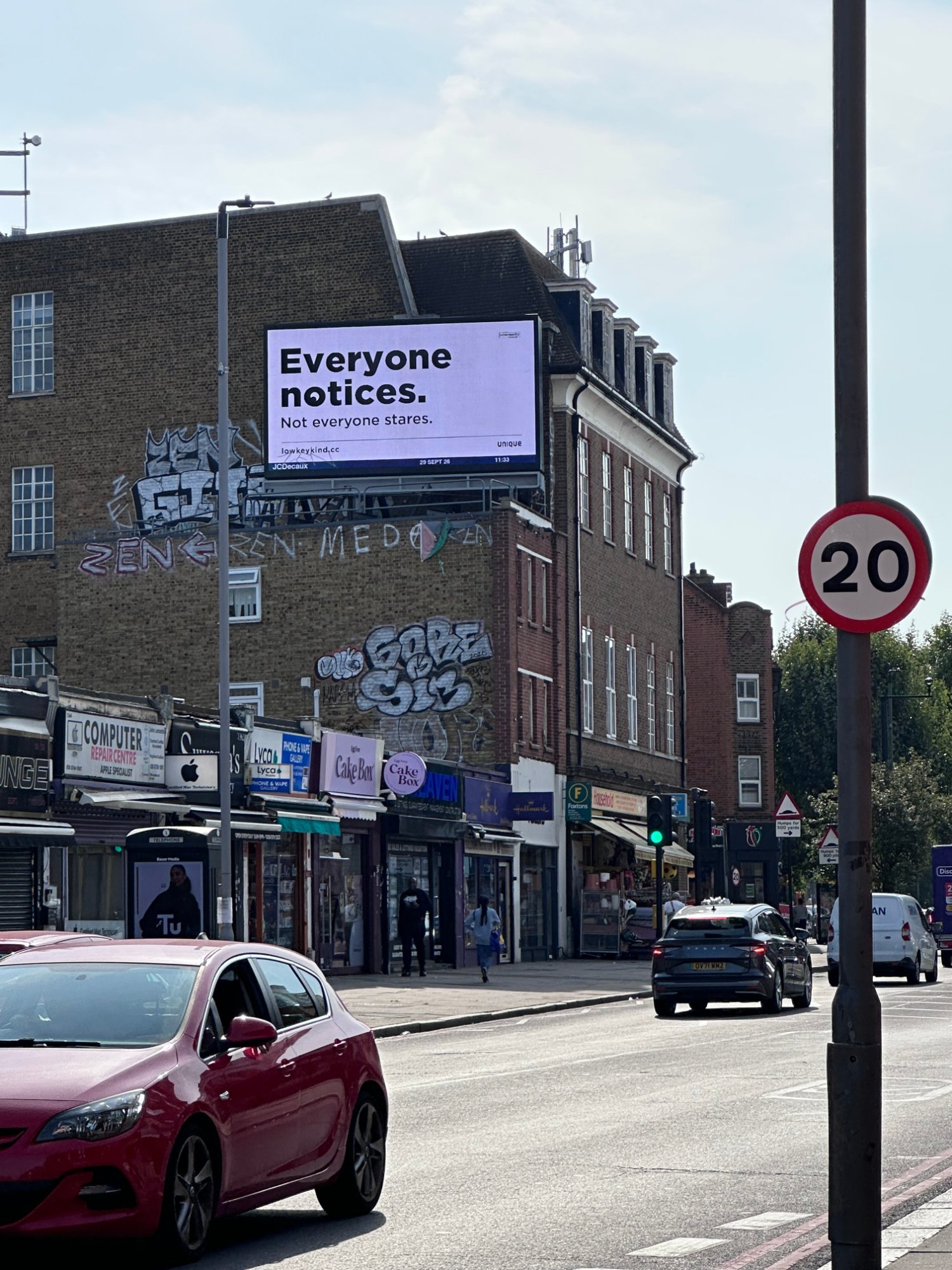
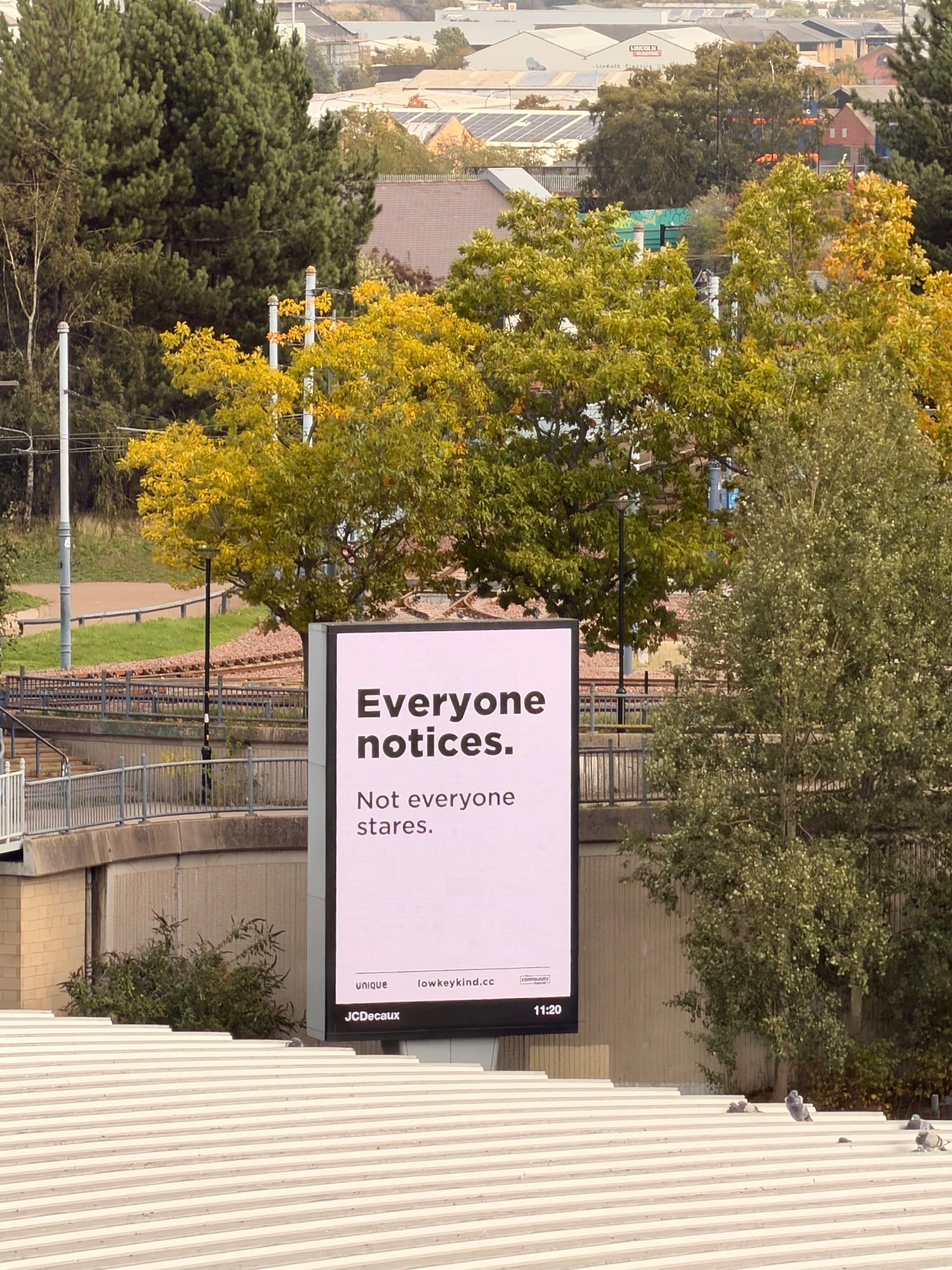
Everyone notices. Not everyone stares.
I wanted the campaign to appear where the behaviour actually happens.
Not just on a charity’s social channels, reaching people who already care about the subject.
In public. Where strangers notice each other all the time.
The posters deliberately avoid the usual charity imagery. No family photographs. No appeal for sympathy. No instruction to be a better person.
Just a few words that make you think about something you might have done yourself.
Everyone notices.
Not everyone stares.
Low-key kind.
I developed the creative and approached JCDecaux, who accepted the campaign into their Community Channel.
In September 2026, Low-key kind began appearing on outdoor advertising sites across the UK.
What started as a small charity brief was now a national campaign, without Unique having to buy the media.
(06 · The website had to behave differently too)
I didn’t want people to arrive at another charity website.
Most people who see a poster about a cause aren’t looking for an organisation to support.
They might be curious for a few seconds. That’s the opportunity.
So I wrote, designed and built lowkeykind.cc as a scrolling story.
One thought at a time.
It begins with the awkwardness most of us recognise. The feeling of trying to get an interaction right, becoming too conscious of ourselves, and sometimes making things more uncomfortable.
Only gradually does it reveal what those small moments can feel like from the other side.
The site moves into real first-person experiences shared by parents in the Unique community, and practical ways to approach familiar situations without adding more awkwardness.
No lecture. No telling people off. No sad music. No donation request waiting at the door.
I wanted people to arrive at the conclusion themselves, because recognising your own behaviour is different from being told to change it.
Make it less of a thing.
That became the organising thought behind the entire experience.
(07 · The campaign doesn’t end at the poster)
From something people see to something they can take part in.
I also built a Noticed Map so people could find campaign locations, photograph posters they spotted and send in their sightings.
A way for the campaign to travel beyond its media schedule, through the people encountering it.
Alongside the website and outdoor work, I developed the social content, bringing the same approach to the conversations happening there.
Instead of turning families into awareness content, the campaign keeps returning to the small interactions people recognise.
The posters start the thought. The website explores it. Families’ experiences give it meaning. Social media keeps the conversation going.
And the entire idea can continue long after the original awareness day.
(08 · Beyond the posters)
Three weeks. Almost 38,000 views.
I didn’t want Low-key kind to disappear when the posters came down.
So I took the idea onto Instagram, sharing real moments from families, the little things we do when we’re trying to be kind, and sightings of the campaign appearing around the country.
37,973
views in three weeks
7,810
accounts reached
789
interactions
79.1%
of views from people not following the account
That’s particularly encouraging because the whole point was to reach beyond the people already connected to Unique.
No guilt. No pity. No emotional fundraising appeal.
Just an idea people could recognise in themselves.
(09 · What it achieved)
One small brief. A national campaign. An idea with somewhere to go.
The original request was for a campaign around one awareness day in June.
What emerged was a separate public-facing platform for Unique, designed to reach beyond its existing community.
A behaviour-led campaign running across hundreds of UK outdoor locations, supported through JCDecaux’s Community Channel.
An interactive website and live map that give people somewhere to go after seeing the posters.
And an ongoing creative platform that isn’t limited to a single diagnosis, one family story or one day of the year.
I took it from the initial research and rejected ideas through to the strategy, writing, identity, design, website, outdoor creative, media outreach and ongoing rollout.
One person, working with Unique and drawing on the experiences families were generous enough to share.
I can’t claim the campaign has changed how everyone behaves. That was never going to be measurable from a few weeks of posters.
But it has put a different kind of conversation into public spaces, without asking families to explain themselves or be the subject of another emotional appeal.
And perhaps the next time someone notices difference, they’ll recognise that little instinct to overcorrect.
And do a little less.
The condition is rare.
The reaction is common.
Find why people aren’t doing it. Then build the thing that makes them want to.
annaliisa@tinyforce.ccThe diagnosis + the creative direction to make it real. One week to find the problem. Then the platform, the naming and the identity to answer it.